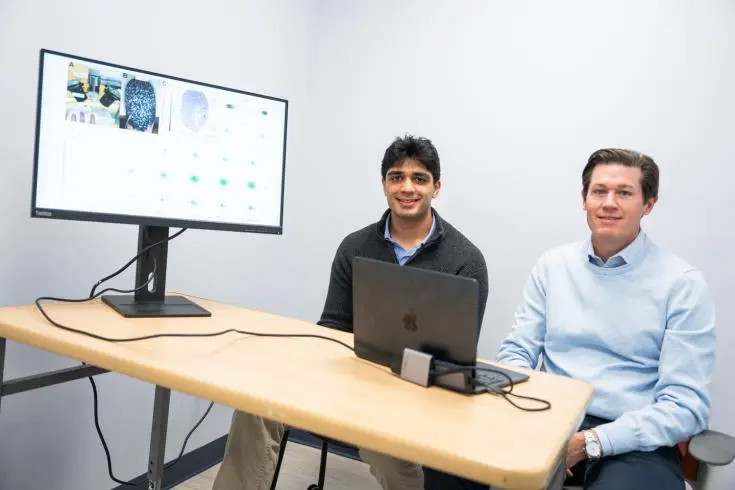
Department chair Greg Gerling is working with second-year Tara Vidyababu and third-year Abhinav Pappu on very different problems — but with a shared emphasis on complex systems.
Pappu, an electrical and computer engineering major, has spent the past year in Gerling’s lab studying haptics and computational neuroscience. He’s developing a biophysically inspired computational model of differential equations that transforms optical measurements of skin deformation at the human finger into neural responses of different touch neurons.
“It’s a pretty novel way to think about sensory neurons in the human finger,” Pappu said. “It bridges hard to measure gaps in the real world using computational models.”
Pappu ultimately foresees applications in technologies that interface directly with people, including assistive devices.
Gerling’s other mentee, Vidyababu, is designing AI-assisted interfaces to help U.S. Marines command and control drones in complex environments.
Working with UVAccelerate M.E. student Drake Ferri, she’s watched the project evolve from early sketches on her iPad to fully interactive prototypes in just a few months.
“The most exciting part is getting to work with experienced military operators to gain direct feedback on our designs,” said Vidyababu, a systems engineering major with minors in data science and general business.
“It’s definitely a learning curve, but extremely eye-opening.”
...

The lab of University of Virginia systems engineer Gregory J. Gerling recently made a discovery on a touchy subject: why women generally seem to have a more acute sense of touch than men.
Their finding upends the long-held belief that digit size is the most determining factor.
“Basically, we confirmed women are better than men at touch discrimination — although not because they have smaller fingers, but because in general they have softer fingers,” said Gerling, a professor in the School of Engineering and Applied Science
...
https://engineering.virginia.edu/news-events/news/researchers-put-finger-why-men-and-women-feel-touch-differently

Prof. Greg Gerling and Systems Engineering PhD Alums Bingxu Li and Steven Hauser were recently awarded the 2024 IEEE Transactions on Haptics Best Paper Award for their paper entitled "Faster indentation influences skin deformation to reduce tactile discriminability of compliant objects.” They along with Russell Sharpe also were awarded the runner-up best technical conference paper at the IEEE Haptics Symposium on April 11th for work entitled "A transparent hydraulic actuator to visualize finger pad deformation at programmable material compliances.”
Link to the first paper: https://doi.org/10.1109/TOH.2023.3253256
Link to the second paper: https://doi.org/10.1109/HAPTICS59260.2024.10520859

Professor Gregory Gerling was awarded two NIH grants, both with collaborator Professor Ellen Lumpkin of the University of California, Berkeley, Molecular and Cell Biology.
R21: Developing A Quantitative, Multiscale Imaging Approach to Identify Peripheral Mechanisms of Noxious and Innocuous Force Encoding in Mouse Models. The goal of this two-year project is to develop multiscale, in vivo imaging approaches to simultaneously quantify 3D skin mechanics and activity of sensory neuron populations, which will allow discovery of neural and non-neural mechanisms through which force-based manipulations govern the senses of touch and pain.
U24: NeuronS_MATTR Network: Neuronal & Systems Mechanisms of Affective Touch & Therapeutic Tissue Manipulation Research Network. The goal of this five-year project is to establish an inclusive research network to identify mechanisms through which soft tissue manipulations exert biological effects on the nervous system, as well as on non-neural cells and tissues. The (NeuronS_MATTR) Network will nucleate an emerging field focused on the neurobiology of soft tissue mechanotherapies. Through combinations of multidisciplinary conferences, summer schools, pilot projects and dissemination programs, NeuronS_MATTR will address high-priority areas to elucidate the neural mechanisms of forced-based manipulations.
Here's a recent message about the U24 award from the NCCIH director! (LINK)

Nice story and Q&A with Chang Xu! (LINK)
We don’t understand how our fingers feel material softness — for example, how do we know a peach is ripe? Touch permeates our lives, yet we don’t design technology to use our natural ability to differentiate objects. Chang Xu, a systems engineering Ph.D. student working in associate professor Greg Gerling’s Touch Lab, is studying the mechanisms underlying our sense of touch in the natural world to improve technologies ranging from consumer electronics to prosthetic hands and robotic-assisted surgery.

.svg)