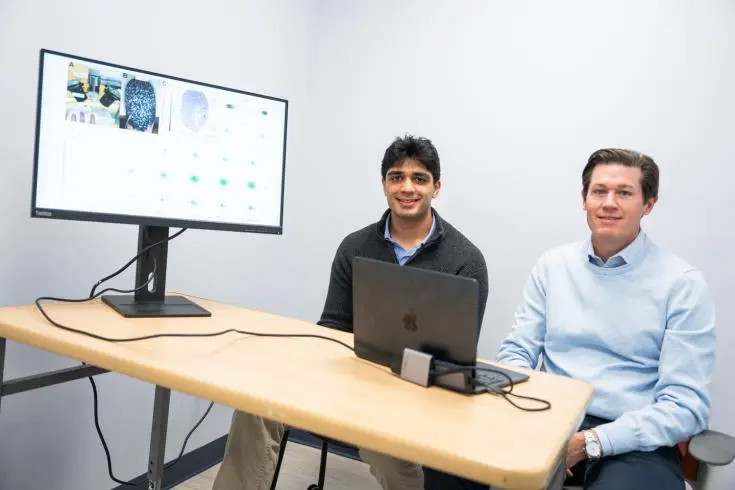
Department chair Greg Gerling is working with second-year Tara Vidyababu and third-year Abhinav Pappu on very different problems — but with a shared emphasis on complex systems.
Pappu, an electrical and computer engineering major, has spent the past year in Gerling’s lab studying haptics and computational neuroscience. He’s developing a biophysically inspired computational model of differential equations that transforms optical measurements of skin deformation at the human finger into neural responses of different touch neurons.
“It’s a pretty novel way to think about sensory neurons in the human finger,” Pappu said. “It bridges hard to measure gaps in the real world using computational models.”
Pappu ultimately foresees applications in technologies that interface directly with people, including assistive devices.
Gerling’s other mentee, Vidyababu, is designing AI-assisted interfaces to help U.S. Marines command and control drones in complex environments.
Working with UVAccelerate M.E. student Drake Ferri, she’s watched the project evolve from early sketches on her iPad to fully interactive prototypes in just a few months.
“The most exciting part is getting to work with experienced military operators to gain direct feedback on our designs,” said Vidyababu, a systems engineering major with minors in data science and general business.
“It’s definitely a learning curve, but extremely eye-opening.”
...

.svg)